

Static KOL lists cannot keep pace with today’s decision-making. A better approach is to treat influence as a living network, grounded in clinical excellence, credible and compliant, and continually updated.
Every year, many teams run the same exercise: “refresh the KOL list”.
It is rarely anyone’s favourite piece of work. It is urgent, high-stakes, and often surprisingly unsatisfying. The list expands. Internal stakeholders want reassurance. External stakeholders want relevance. Compliance wants clarity. And somewhere in the middle, the question that matters most can get lost:
Are we capturing influence or just documenting visibility?
And there is a second question that matters just as much: are we recognising expertise or rewarding profile? The future of KOL strategy depends on getting that distinction right.
Titles, podiums, publication history and congress presence remain important signals. They are measurable. They are easy to defend internally. They can be useful shorthand. But they are not always a reliable proxy for what shapes day-to-day clinical decisions, adoption, or behaviour.
The reason is simple: influence in ophthalmology has become more networked, more contextual, and more relationship-driven than any static KOL list can reflect, and the most durable influence remains anchored in real clinical judgement.
We see this repeatedly in our work with ophthalmology companies: even well-run programmes can be constrained by static lists and visible metrics, which do not always reflect the expertise-led networks that are shaping adoption. That is one reason our ArC framework starts with how influence truly moves, not how it is easiest to document.
Expertise earns trust. Systems sustain it.
A list is a snapshot. A system is an operating model.
1. Why the KOL list is failing (and why it is nobody’s fault)
The KOL list was built for a world where influence was more hierarchical: evidence was generated, presented, published, and broadly disseminated through formal channels. In that environment, identifying the most visible senior experts could serve as a workable proxy for credibility and reach.
That model still matters. But it is no longer the full picture.
What has not changed is the foundation: in ophthalmology, lasting influence is still earned through clinical excellence and trusted judgement. What has changed is how that expertise travels and how it is validated.
Ophthalmology is a particularly relationship-driven specialty. Decisions are shaped not only by data, but by who a clinician trusts, who they trained with, who they operate alongside, and whose judgement they rely on when navigating nuance: patient selection, workflow, outcomes, complications, and the practical realities that do not always make it into a slide deck.
As a result, expertise-led influence often sits in places that lists struggle to capture:
- peer-to-peer reinforcement within local communities
- informal leadership that is visible only once you are “inside the room”
- workflow confidence that determines whether evidence becomes action
- the quiet credibility of clinicians who are sought out for practical judgement
“When I decide whether to adopt something new, I don’t look for the biggest name. I look for the person I trust to tell me what happens in real clinics, with real patients, on real Mondays.”
Miss Radhika Rampat, Consultant Ophthalmic surgeon / @eyefluencerrr, London
When programmes are built primarily around what is easiest to point to, they can look robust on paper and still underperform in practice. Not because anyone has made a mistake, but because the system has changed.
2. What a list can never capture
A KOL list is a snapshot. It freezes a moment in time. The challenge is that influence is not static—and it is not universal.
Here are five dynamics that lists routinely miss:
i) Context specificity
The influential voice in one market, hospital group, or referral setting may be far less relevant in another. Ophthalmology is full of highly localised practice patterns. Influence is often contextual: it depends on geography, setting, and what “good” looks like in that environment.
ii) Role-based influence
Expertise-led influence does not sit only with society figureheads or the most published names. It often sits with trainers, service leads, implementers, and those who shape day-to-day norms. These are frequently the people colleagues ask when they want practical assurance, not theoretical reassurance.
iii) Time sensitivity
Influence changes by lifecycle stage and by the question being asked. Early on, the decision may hinge on scientific credibility and confidence in evidence. Later, it may hinge on workflow, economics, scalability, and “what happens when this meets real-world variability”. One list cannot serve every stage or every decision.
iv) Hidden connectors
Some individuals bridge communities: between subspecialties, between centres, between generations, or between clinical and operational worlds. They are not always the most visible—but they are often the reason ideas travel, adoption accelerates, and consensus forms.
v) Trust and consistency
In a relationship-driven specialty, influence often accrues quietly over time. It is built through repeated, consistent judgement—especially when things are uncertain. It does not always correlate with audience size or conference visibility. In a regulated specialty, that consistency is usually rooted in outcomes, judgement, and professional discipline—not visibility.
Glossary
- List mindset: a static KOL list of visible names, refreshed periodically.
- System mindset: a living view of influence by context, role, and lifecycle stage.
- Credibility: clinical expertise, outcomes-informed judgement, and professional trust.
- Connectivity: the ability to move ideas through networks and communities.
- Expertise-led influence: influence that is sustained because it is grounded in demonstrable clinical excellence.
3. The alternative: an influence system
If lists are snapshots, what replaces them?
Not “a bigger list”. Not a more complex database. And not more activity.
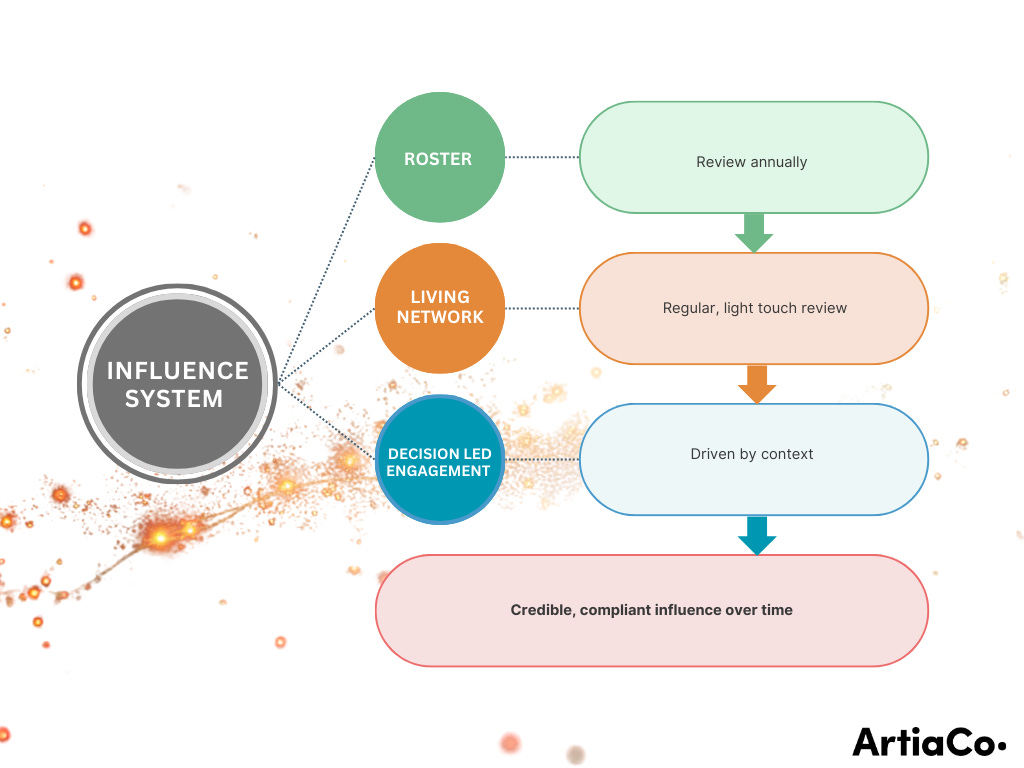
A modern approach is to build an influence system: a living view of who shapes decisions, how ideas move, and what matters now—by context, role, and lifecycle stage—while remaining credible and compliant by design.
Crucially, it is not a way to amplify voices for their own sake; it is a way to ensure the voices being amplified are the ones whose expertise will stand up in practice.
An influence system does not treat influence as a fixed ranking of names. It treats it as a structured way to recognise and engage expertise in context.
It helps to answer questions such as:
- Where is adoption actually being decided in this market?
- Who shapes confidence, not just awareness?
- Who connects communities and accelerates diffusion?
- Which voices matter at this stage—and which will matter next?
- How do we engage in a way that protects credibility and withstands scrutiny?
A list is a record. A system is a capability.
4. What “good” looks like
An influence system should feel modern, but also disciplined. Here are five high-level principles that define what “good” looks like.
i) Decision-led, not fame-led
Start with how decisions are made, rather than the KOL profile. The key question is not “Who is most visible?” but “Where is adoption decided — and who shapes it?” The most trusted decisions are driven by credible clinical judgement, often ahead of public visibility.
ii) Segmented by context
Influence should be mapped by the realities that change behaviour: market structure, setting, subspecialty, access constraints, workflow, and cultural norms. One-size-fits-all influence is usually an illusion.
iii) Balanced voice architecture
Sustained influence depends on a bench of credible expertise: senior authority, practical implementers, emerging leaders, connectors. Not because diversity is a buzzword, but because complex systems rarely move through one type of voice.
iv) Refresh built in
The annual KOL list scramble is a sign that a static list is no longer designed to stay current. A better model is light-touch, continuous refresh: enough to stay current, not so much that it becomes noise. This is a governance issue as much as an operational one.
v) Governance by design
Influence is reputational capital. Engagement should be designed in a way that protects credibility—transparent, fair, and defensible. This is not a constraint; it is how trust is sustained. Governance protects what matters most: the integrity of expertise and the trust that sits around it.
“The companies I respect are the ones that understand my constraints—not just my credentials. Relevance is what builds trust.”
Dr. Ruth Lapid Gortzak, Consultant Ophthalmologist, Netherlands
5. Why this approach is inherently more compliant and credible
In the most regulated environment, the easiest path to risk is improvisation: ad hoc selection, inconsistent rationales, and engagement driven by convenience rather than strategy.
A system-led approach tends to reduce fragility because it creates consistency:
- clearer rationale for why specific experts matter in specific contexts
- less reliance on “the same visible names” as a default
- fewer last-minute decisions that create documentation gaps
- more transparency and fairness in how voices are identified and engaged
It also protects the credibility of the expertise being shared. In a small, relationship-driven specialty, reputations travel quickly. A system that rewards relevance and rigour—rather than familiarity—earns trust over time.
6. What this changes in 2026
Several forces are accelerating this shift.
Professional influence is now visible in real time. Peer dialogue, shared interpretation, and informal consensus leave traces across both digital and in-person channels. That does not replace traditional leadership, but it changes how leadership is recognised and validated.
Local communities remain decisive. Even when a global narrative is strong, adoption often hinges on whether peers see it as workable, safe, and worth the effort.
And the next generation expects a different style of leadership: dialogue, transparency, and relevance—not performance.
KOL management is becoming influence management—more strategic, more accountable, and more human.
But influence must be backed by excellence in clinical expertise—otherwise it becomes noise with reach. The future belongs to clinicians who combine rigour with accessibility, whose reach is underpinned by genuine competence, good judgement, and disciplined communication.
7. Practical takeaways
If you are resetting your approach this year, five shifts can help.
- Stop asking “Who are the top 20?” Start asking “Where does adoption get decided?”
- Separate credibility from connectivity. Do not assume they sit together.
- Build a bench, not a podium.
- Refresh continuously, lightly—so you stay current without creating noise.
- Treat governance as a way to protect credibility and trust — not as a box to tick for compliance.
If this resonates and you would like an informal discussion on how to move from static KOL lists to living influence systems, without compromising clinical credibility or compliance, comment below!
